Why audits and AI-generated code pass pre-deployment checks but fail on mainnet. Covers the gap between static analysis and on-chain behavior, Solana's 400ms speed gap, why vibe coding makes this worse, and what actually works for post-deployment security.
Why Does Post-Deployment Behavior Change Everything for Smart Contract Security?
Source question: r/CryptoTechnology: “why does post deployment behavior change everything?”
If you have been around smart contract development for any length of time, you have seen this pattern. A protocol passes its audits. The code is clean. Three weeks later, it is drained. The exploit was not a bug in the source. It was a sequence of valid transactions that no auditor could have flagged because the sequence did not exist yet.
The question is not whether this happens. Everyone in the space knows it happens. The question is why, and why it is about to get worse.
There are three structural reasons. First, audits and chains answer different questions. An audit asks “does this code do what the developer intended?” The chain answers “given this state, these accounts, and this transaction ordering, what actually executed?” Second, Solana’s 400-millisecond block time means settlement outruns detection by two orders of magnitude. By the time a monitoring system flags an anomaly, the outcome is finalized. Third, a new wave of solo founders is deploying AI-generated Solana programs that compile correctly but have no understanding of on-chain behavior. They have no feedback loop between deployment and disaster.
These are not three separate problems. They are three layers of the same problem: pre-deployment models cannot predict post-deployment behavior. Here is why, and what actually works.
Audits Verify Code. Chains Verify Behavior.
A smart contract audit asks one question: does this code do what the developer intended?
The auditor reads the source. They check for reentrancy, integer overflows, access control flaws, and missing signer checks. They run fuzzers and static analyzers. They produce a report.
Then the contract goes live. And behavior appears that no audit could have predicted.
On-chain behavior is not a property of the code. It is a property of the code, plus the ordering of transactions, plus the accounts those transactions touch, plus the timing between them, plus the state of every other program on the chain at the moment of execution. Audits verify one equation. The chain runs millions.
This is why self-auditing matters before you ever hire a professional auditor. A self-audit finds the obvious bugs so the external auditor can find the subtle ones. It forces you to model what the chain will actually do to your code. Three days of writing exploit tests against your own protocol teaches you things no audit report can. When I self-audited chaotic.markets, three of the four critical findings were one-line fixes. The bugs were not subtle. They were invisible from the source code alone. They only became obvious when I modeled the attack. But even a self-audit followed by a professional audit is still pre-deployment. The chain has not spoken yet.
What Post-Deployment Behavior Actually Looks Like
Take a sandwich attack on a Solana AMM.
Trader A submits a swap of 100 SOL for USDC. Trader B sees it in the mempool. Trader B submits a buy before Trader A, then a sell after.
Each of these three transactions is valid. Each passes every access control check. The program never panics. The signing is correct. The math inside the swap instruction computes correctly for every individual call. The exploit is in the sequence, not the code. No pre-deploy audit checks transaction ordering. They cannot. The ordering does not exist yet.
Now scale this to Solana’s parallel execution model. Solana executes transactions in parallel when they touch different accounts. The runtime determines which transactions conflict and runs the rest concurrently. This is what makes Solana fast. It is also why post-deployment behavior resists static prediction.
A transaction that passes every test in isolation can fail when the runtime schedules it next to another transaction that touches an overlapping account. Or it can succeed but produce a different result than expected because state changed between the time it was built and the time it landed. The developer sees “transaction succeeded.” The auditor sees “logic is correct.” The chain just executed something neither of them modeled.
The Speed Gap: 400ms vs 30 Seconds
Solana produces a block every 400 milliseconds. A single MEV searcher can land a bundle of transactions, extract value, and have the whole thing finalized before most monitoring systems even receive the event. Most on-chain detection systems operate in seconds. Some take minutes. A few claim “real-time” but mean 2-3 second latency.
If the detection window is 30 seconds and the settlement window is 400 milliseconds, detection is a post-mortem.
MEV searchers and block builders already operate at the right timescale. They simulate entire bundles together, not individual transactions, because individual validation tells you nothing about the combined outcome. They score the bundle, not the parts. Post-deployment security needs the same discipline: simulate what will actually execute, not what should execute in isolation.
Vibe Coding on Solana: A Structural Hazard
A new kind of builder is deploying to Solana mainnet right now. Solo founders, first-time creators, people who asked an AI to write their smart contract and deployed the result because it compiled.
Call it what you want. The numbers are what they are. AI coding tools have lowered the barrier to deployment. Anyone can generate an Anchor program in five minutes. The code will compile. It will look correct. The AI was trained on audited, production-grade Solana programs, so the patterns are recognizable. The #[derive(Accounts)] macro will have the right fields. The CPI calls will use the right accounts.
And it will get drained.
The AI does not understand what it generated. It was not trained on post-deployment outcomes. It was trained on source code. It knows that init_if_needed exists, so it uses it. Unaware that init_if_needed on an ATA was the vector for the Nirvana Finance hack. It knows that minimum_amount_out is a field in the swap instruction, so it sets it to zero. Unaware that this makes every swap a sandwich target. It knows that UncheckedAccount exists, so it uses it liberally. Unaware that every unverified account is an entry point for a fake-pool drain.
The vibe coder deploys. The token launches. Users ape in. The curve works for a day. Then someone passes a malicious pool state, or sandwiches the zero-slippage swap, or front-runs the PDA with a symbol collision. The treasury is gone. The discord goes silent.
None of these attacks were in the AI’s training data as “do not do this.” They exist only as on-chain behavior, as sequences of transactions that exploited the gap between what the code said and what the chain executed. The solo founder does not have a team to catch this. They do not have an auditor. They have a Discord community that expects the token to go up and a codebase they did not write and do not understand. When the exploit hits, they do not even know where to look.
This is not a problem of intelligence. It is a problem of feedback loops. The AI gives you correct-looking code immediately. The chain gives you feedback 48 hours later, in the form of a drained treasury. In between, there is nothing. No simulation. No invariant check. No account validation walkthrough. No one asking “what happens if the caller passes a fake pool?”
The fix is not “don’t use AI.” The fix is understanding that AI-generated code passes the compiler, not the chain. The compiler checks syntax. The chain checks behavior. They are not the same thing.
A three-day self-audit is the cheapest feedback loop that exists between “it compiles” and “it’s on mainnet.” It guarantees one thing: you know where the attacks are before the chain shows you.
Behavioral Detection vs Static Analysis
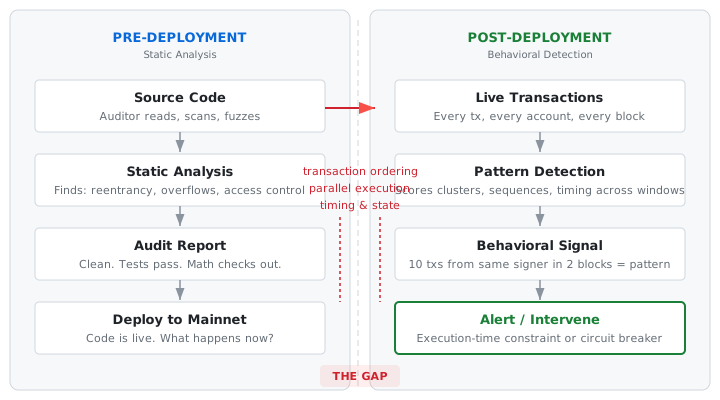
Static analysis answers: given this code, what could go wrong?
Behavioral detection answers: given these transactions, what actually happened?
They answer different questions. One is not a replacement for the other. The problem is that most DeFi security stops at the first question.
Consider detecting money mule behavior on-chain. A static rule flags a wallet that sends funds to a sanctioned address. Simple, fast, and trivially bypassed. The mule splits the transfer across five wallets first. A behavioral detector looks at the pattern: rapid splitting into fresh wallets, amounts just below reporting thresholds, no DeFi interaction between splits, all wallets funded from the same source. This pattern emerges only from watching behavior over time. No single transaction looks suspicious.
The same principle applies to protocol security. A single failed transaction means nothing. A cluster of failed transactions from the same signer targeting the same instruction, increasing in gas priority. That is a pattern. That is behavior. That is actionable.
What Actually Works
The projects that get post-deployment security right share a few characteristics. None of this is theoretical. Each principle maps to tools and patterns that exist today. And to gaps that people are actively asking about.
Simulate Against Mainnet State, Not a Test Environment
A developer on Solana StackExchange asked what teams use to monitor Anchor program failures in production. The answer acknowledged a gap: there is no Tenderly equivalent for Solana. No dashboard that shows you every failed transaction, decoded error, and state change in real time.
The tools that do exist are lower-level. simulateTransaction RPC lets you dry-run a transaction against the current chain state before submitting it. solana-test-validator --clone <address> lets you fork specific accounts and programs into a local environment. Surfpool and liteSVM let you run tests against forked mainnet state with cheatcodes for minting tokens and manipulating accounts.
The pattern is the same across all of them: test against what the chain actually looks like right now. Not what it looked like when you deployed. Not against devnet. Against mainnet state at the slot you intend to land in. This catches failures that local validators miss because they do not have the same account state, the same program versions, or the same concurrent transaction load.
Score Behavior Across Time Windows, Not Individual Events
A post on r/ethdev with 28 upvotes described a familiar failure: audits passed, tests passed, the contract went live, and then the monitoring system fired alerts. After the damage was done. The top comment identified the gap precisely: “pre-execution simulation in the mempool window and in-contract circuit breakers are the only points you can intervene, and most setups have neither.”
One anomalous transaction is noise. Ten anomalous transactions from the same signer within two blocks is a signal. The difference is time-window scoring. Most monitoring tools are event-driven. They fire on a threshold crossing, a failed transaction, a balance change. By the time the event fires, the outcome is settled.
Behavioral detection looks at patterns across time: a cluster of failed transactions from the same signer targeting the same instruction, increasing in gas priority. A sequence of withdrawals that individually pass every check but together drain the treasury. These patterns emerge only when you score across a window, not an instant.
Build Execution-Time Constraints
The ideal is not “alert me when something bad happens.” It is “prevent the thing from happening at all.”
Lighthouse is an on-chain program that does exactly this. It appends assertion instructions to a transaction before it lands. If the assertion fails: the mint freeze authority is not null, the balance is below X, or the account is not what it should be. The entire transaction reverts. The check happens at execution time, not audit time.
This is a fundamentally different security model. Audits verify code before deployment. Execution-time constraints verify outcomes at the moment of execution. One is a model. The other is the chain.
MEV searchers already operate this way. They simulate the bundle, check the outcome, and only submit if the result is profitable. Post-deployment security needs the same discipline: simulate the outcome, check for harm, and only allow execution if the result is safe. The tools exist. The pattern is known. Most projects just do not use them yet.
The Chain Is the Only Source of Truth
An audit report is a model of the code. A test suite is a model of expected behavior. AI-generated code is a model of syntax that compiled. None of them is the chain.
What actually executed, in what order, with what accounts, at what time. That is the chain. It is the only source of truth for post-deployment behavior.
Developers who treat the audit, or the compiler, as the finish line are betting that their model of the code matches the reality of the chain. It almost never does. Not because the audit was bad or the AI was wrong. Because no pre-deployment model captures what the chain will actually do.
The fix is not better audits or better AI. It is recognizing that audits, compilers, and code generators are pre-deployment. Behavior is post-deployment. They answer different questions.
Build for the chain, not the audit. Build for the chain, not the compiler.
This article answers a question from r/CryptoTechnology. Every cryptogrammar article starts with a real question someone asked.
Read the three-day self-audit methodology that found four critical bugs before an external auditor ever touched the code.
cryptogrammar.xyz. On-chain data, math, and tradeoffs.