A proof-of-concept algorithm that matches Tornado Cash deposits to withdrawals using a 4-point behavioral scoring system. Demonstrates how transaction attribution can break mixer privacy guarantees.
Tornado Cash Intelligent Demixer: Transaction Attribution Through Behavioral Analysis
What if we can build an algorithm, that matches deposits to withdrawals in a tornado cash trasaction? Doesn’t that break the whole privacy aspect that it promises? This tutorial build a POC trying to match deposits-withdrawals using a 4-point scoring system.
I received some valuable feedback for this POC in my linkedin post, which I plan to implement soon.
In the spirit of literate programming, this article will have the code files linked in raw format. Just as Donald Knuth’s programs weave together code and explanation, we’ll explore how to match deposits to withdrawals, detect behavioral patterns, and identify network connections in privacy-preserving transactions.
Repository: tornado-cash-intelligent-demixer
Overview
Tornado Cash is a privacy-preserving protocol that breaks the link between deposit and withdrawal addresses using zero-knowledge proofs. However, privacy can be compromised through behavioral patterns, timing analysis, and network graph analysis. This methodology extends the same fund-flow tracing approach used in the Hedgey Finance exploit post-mortem and the TRON mule offramp investigation. This tool demonstrates how to:
- Match deposits to withdrawals using temporal and value-based heuristics
- Detect address reuse patterns that compromise privacy
- Analyze relayer behavior and fee structures
- Track nullifier usage to detect potential double-spends
- Build network graphs to identify connected addresses
Architecture
The system consists of four main components:
1. Data Fetching Layer
The afetch.py module handles all interactions with the Bitquery GraphQL API. It retrieves both transfer events and contract events (Deposit/Withdrawal) to build a complete picture of Tornado Cash activity.
@dataclass
class TornadoTransaction:
    """Represents a Tornado Cash transaction"""
    tx_hash: str
    from_address: str
    to_address: str
    value: str
    block_time: str
    gas: int
    call_signature: str
    transaction_type: str  # 'deposit' or 'withdraw'
    commitment: str = None  # bytes32 from Deposit event
    nullifier: str = None  # bytes32 from Withdrawal event
    recipient: str = None  # address from Withdrawal event
    relayer: str = None  # address from Withdrawal event
    fee: str = None  # uint256 from Withdrawal event
The BitqueryFetcher class provides two primary methods:
get_deposits_and_withdrawals_via_transfers(): Captures all transfers to/from Tornado Cash contractsget_deposit_events()/get_withdrawal_events(): Retrieves specific contract events for detailed analysis
2. Configuration Management
The config.py module maintains:
- OFAC-sanctioned contract addresses across multiple networks (Ethereum, Polygon, BSC)
- Pool denominations mapping contract addresses to their pool sizes (0.1 ETH, 1 ETH, 10 ETH, 100 ETH)
- Analysis parameters like time tolerance windows and value matching thresholds
# Default analysis configuration
DEFAULT_TIME_TOLERANCE_SECONDS = 7200  # 2 hours
DEFAULT_NETWORK_WINDOW_DAYS = 14
VALUE_TOLERANCE_PERCENT = 0.01  # 1% tolerance for matching amounts
3. Scoring Algorithm
The scoring.py module implements the matching heuristics. The core function calculate_match_score() combines multiple signals:
def calculate_match_score(
    time_diff_seconds: float,
    tolerance_seconds: float,
    deposit_value: Optional[float],
    withdrawal_value: Optional[float],
    same_contract: bool,
    same_pool: bool,
) -> float:
    """Lower scores indicate better matches"""
    time_score = time_diff_seconds / tolerance_seconds
    amount_score = abs(deposit_value - withdrawal_value) / deposit_value
    contract_bonus = 0.0 if same_contract else 0.3
    pool_bonus = 0.0 if same_pool else 0.5
    return time_score + amount_score + contract_bonus + pool_bonus
Scoring factors:
- Time proximity: Closer transactions score better
- Amount similarity: Matching values reduce the score
- Contract match: Same contract address reduces score by 0.3
- Pool match: Same pool denomination reduces score by 0.5
4. Core Analysis Engine
The tornado_analyzer.py module orchestrates the analysis. The TornadoCashAnalyzer class provides several key methods:
Matching Deposits to Withdrawals
The match_deposits_withdrawals() method implements a greedy matching algorithm:
def match_deposits_withdrawals(
    self,
    tolerance_seconds: int = 1209600,  # 2 weeks
    value_tolerance_percent: float = 0.05
) -> List[Dict]:
    """One-to-one matching using greedy algorithm with scoring"""
    # Generate all candidate pairs
    candidates = []
    for deposit in self.deposits:
        for withdrawal in self.withdrawals:
            if withdrawal_time > deposit_time:
                if time_diff <= tolerance_seconds:
                    score = calculate_match_score(...)
                    candidates.append({...})

    # Sort by score and greedily match
    candidates.sort(key=lambda x: x['score'])
    matches = []
    matched_indices = set()
    for candidate in candidates:
        if candidate['deposit_idx'] not in matched_indices:
            matches.append(candidate)
            matched_indices.add(...)

    return matches
Matching constraints:
- Withdrawal must occur after deposit
- Time difference within tolerance window (default: 2 weeks)
- Amounts match within tolerance (accounts for relayer fees)
- One-to-one matching (each deposit/withdrawal matched at most once)
Address Reuse Detection
Privacy is compromised when addresses appear in multiple transactions:
def find_address_reuse(self, transactions: List[TornadoTransaction]) -> Dict[str, int]:
    """Find addresses appearing in multiple transactions"""
    address_counts = Counter()
    for tx in transactions:
        address_counts[tx.from_address] += 1
        address_counts[tx.to_address] += 1
    return {addr: count for addr, count in address_counts.items() if count > 1}
Network Pattern Analysis
The analyze_network_patterns() method builds temporal graphs to identify connected addresses:
def analyze_network_patterns(self, window_days: int = 14) -> Dict:
    """Analyze connections between addresses within time windows"""
    # Group transactions by time windows
    # Build adjacency lists for addresses
    # Identify clusters and patterns
Relayer Analysis
Relayers facilitate withdrawals by paying gas fees. Analysis includes:
- Relayer usage patterns: Which relayers are most active
- Fee structures: How much relayers charge
- Recipient diversity: How many unique addresses each relayer serves
def analyze_relayers(
    self,
    contract_addresses: List[str],
    limit: int = 1000,
    network: str = "eth"
) -> Dict:
    """Analyze relayer behavior and patterns"""
    withdrawals = self.get_withdrawal_events(...)
    relayer_stats = defaultdict(lambda: {
        'count': 0,
        'total_fees': 0,
        'recipients': set()
    })
    # Aggregate statistics by relayer address
Nullifier Analysis
Nullifiers prevent double-spending. The analysis tracks:
- Nullifier reuse: Potential double-spend attempts
- Nullifier patterns: Timing and frequency of nullifier usage
def analyze_nullifiers(
    self,
    contract_addresses: List[str],
    limit: int = 1000,
    network: str = "eth"
) -> Dict:
    """Analyze nullifier usage patterns"""
    withdrawals = self.get_withdrawal_events(...)
    nullifier_counts = Counter(tx.nullifier for tx in withdrawals)
    # Detect potential double-spends
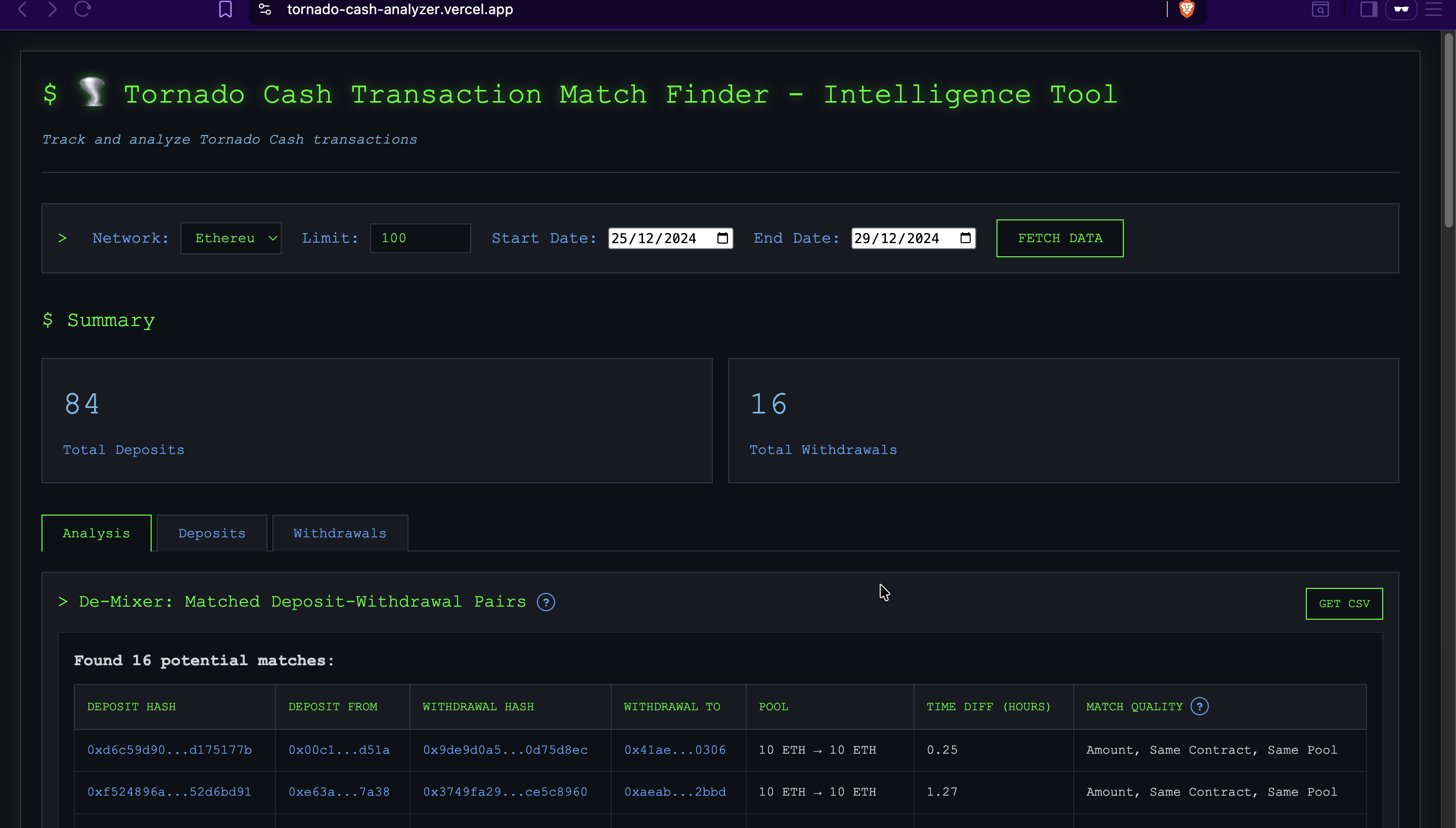
5. Web Interface
The app.py module provides a Flask-based web UI with several endpoints:
/api/fetch: Fetch deposits, withdrawals, and analysis/api/summary: Get summary statistics without full data/api/deposits: Lazy-load deposit data/api/withdrawals: Lazy-load withdrawal data/api/relayer-nullifier-analysis: Heavy analysis endpoint/api/matched-pairs.csv: Export matched pairs as CSV
The UI displays:
- Deposit and withdrawal tables
- Matched pairs with confidence scores
- Address reuse patterns
- Timestamp analysis (daily/hourly activity)
- Network pattern visualizations
How De-Mixing Works
The de-mixing algorithm combines multiple heuristics:
1. Temporal Analysis
Transactions occurring close in time are more likely to be related. The default tolerance is 2 weeks, but this can be configured.
2. Value Matching
Withdrawals should match deposit amounts (minus relayer fees). The algorithm allows a 5% tolerance to account for:
- Relayer fees
- Gas costs
- Rounding differences
3. Contract/Pool Matching
Transactions using the same contract or pool denomination are more likely to be related. The scoring algorithm heavily weights this factor.
4. Behavioral Patterns
- Address reuse: If an address appears in multiple transactions, it’s likely controlled by the same entity
- Timing patterns: Clusters of activity suggest coordinated behavior
- Network connections: Addresses that interact within time windows may be related
5. Greedy Matching Algorithm
The algorithm uses a greedy approach:
- Generate all candidate deposit-withdrawal pairs
- Score each candidate using the heuristics
- Sort candidates by score (lower is better)
- Greedily match pairs, ensuring one-to-one correspondence
Usage Example
from tornado_analyzer import TornadoCashAnalyzer
import config

# Initialize analyzer
analyzer = TornadoCashAnalyzer(
    oauth_token="your_bitquery_token",
    network="eth"
)

# Fetch transactions
contracts = config.get_tornado_cash_addresses("eth")
analyzer.get_deposits(contracts, limit=1000)
analyzer.get_withdrawals(contracts, limit=1000)

# Match deposits to withdrawals
matches = analyzer.match_deposits_withdrawals(
    tolerance_seconds=1209600,  # 2 weeks
    value_tolerance_percent=0.05
)

# Analyze patterns
reused_addresses = analyzer.find_address_reuse(
    analyzer.deposits + analyzer.withdrawals
)
network_patterns = analyzer.analyze_network_patterns(window_days=14)

# Generate report
report = analyzer.generate_report(contracts, limit=1000, network="eth")
Key Insights
Privacy Compromises
- Address Reuse: Using the same address for multiple deposits/withdrawals links transactions
- Timing Patterns: Rapid deposits and withdrawals suggest coordinated activity
- Amount Patterns: Using exact same amounts across transactions creates patterns
- Relayer Usage: Consistent relayer usage can link transactions
Limitations
- False Positives: Matches are probabilistic, not deterministic
- Time Windows: Configurable tolerance may miss legitimate matches
- Network Effects: External factors (market conditions, gas prices) affect timing
- Zero-Knowledge Proofs: The cryptographic privacy guarantees remain intact; this tool analyzes metadata
Conclusion
This tool demonstrates how behavioral analysis can reveal patterns in privacy-preserving protocols. While Tornado Cash’s cryptographic guarantees remain strong, metadata analysis can provide insights for:
- Compliance: Identifying potentially sanctioned transactions (see also Google Dorks for Smart Contract Security for open-source investigation techniques)
- Research: Understanding usage patterns and privacy practices
- Education: Demonstrating privacy trade-offs in blockchain systems. MEV block builders face related attribution challenges in private mempool analysis.
The codebase follows literate programming principles, with each module clearly documented and linked. The implementation is modular, allowing researchers and developers to extend the analysis with additional heuristics or integrate it into larger systems.
Explore the code:
tornado_analyzer.py- Core analysis enginescoring.py- Matching heuristicsafetch.py- Data fetching layerapp.py- Web interfaceconfig.py- Configuration
Repository: tornado-cash-intelligent-demixer